
You may have cooked them without a second thought, and that’s quite common. However, in spring, certain vegetables are best enjoyed raw, offering a fresher taste and sometimes even more health benefits. Surprisingly, it often only takes a simple seasoning to completely transform their flavor.
Why Cooking Diminishes The Appeal Of These Vegetables
While heat doesn’t destroy everything, it can damage some delicate nutrients, particularly vitamin C and various polyphenols. As soon as water heats up, a portion of these components escapes or degrades. The result is that the vegetable remains edible, yet loses some of its vibrant qualities.
This is especially true for young, tender, and water-rich vegetables. In spring, they are often harvested at a peak flavor moment. Cooking them can sometimes strip away the brilliance that makes them so enjoyable.
Then there’s the flavor. Raw vegetables often possess more crunch, freshness, and sometimes even more natural sweetness. This contrast can be surprising; you think you know an ingredient, then you taste it differently, and everything changes.
The 4 Spring Vegetables Best Enjoyed Raw
These four vegetables share a simple characteristic: they greatly benefit from being eaten raw rather than cooked. No complicated techniques are required—just ensure freshness and good seasoning.
1. Fresh fava beans
Young fava beans are delightful when eaten raw, especially when they are small and tender. Their skin is still thin, their texture is soft, and they have a subtly sweet taste. When cooked, they can become bland and lose some of their character.
Try serving them with a drizzle of olive oil, a pinch of salt, and a few mint leaves. For a simple serving, use 200 g of fresh fava beans for 2 people, along with 1 tablespoon of olive oil, 1 pinch of salt, and a few mint leaves.
2. Fresh peas
Raw peas have an astonishing quality. They are sweet, crunchy, and almost sugary. From the moment they are picked, their sugars begin to transform, which is why it’s best to eat them quickly after shelling.
Consider incorporating them into a salad with fresh cheese and a splash of lemon. For 2 to 3 people, use 250 g of shelled peas, 80 g of fresh goat cheese, 1 tablespoon of lemon juice, and a small handful of mint. It’s simple yet incredibly delicious.
3. Young zucchini
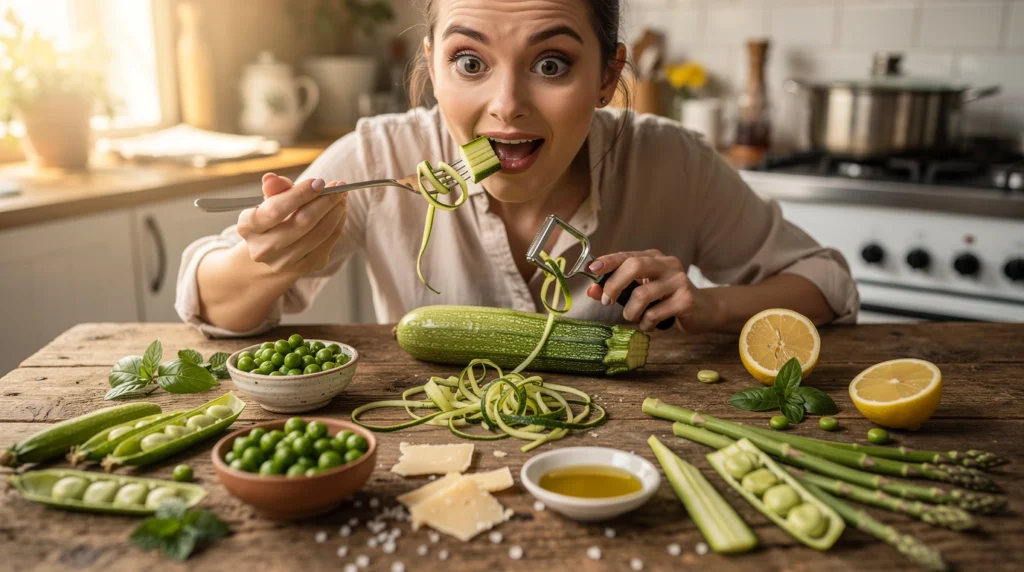
The first zucchinis of spring are often small, slender, and very tender. Raw, they have a delicate texture and a mild flavor. They pair beautifully with fresh herbs, lemon, and a touch of olive oil.
Slice them into thin rounds or ribbons using a vegetable peeler. For a quick dish, use 1 medium zucchini, 1 tablespoon of olive oil, 1 tablespoon of lemon juice, and a pinch of fleur de sel. Feel free to add basil or dill for extra flavor.
4. Fine green asparagus
People often think of cooking asparagus, but fine green asparagus is delicious raw when young. Their flavor is vibrant, vegetal, with a pleasant hint of bitterness. It’s a different way to experience them.
The simplest preparation is to slice them into very thin strips. For 2 people, plan for 8 to 10 fine green asparagus, 1 tablespoon of olive oil, 1 tablespoon of lemon juice, and some shaved parmesan if desired. You’ll have a refreshingly elegant appetizer with minimal effort.
How To Season Them For Maximum Flavor
Raw vegetables that are poorly seasoned can taste flat. This is often where disappointment arises. In reality, it simply requires awakening their flavors with three key elements: salt, acidity, and good fat.
Salt enhances the flavors. Lemon or vinegar adds depth. Olive oil brings roundness. With these three components, a raw vegetable becomes much more interesting.
You can also incorporate fresh herbs. Mint, basil, dill, or parsley work wonderfully, imparting a sense of garden-freshness that is exactly what we crave in spring.
Changing Your Habits Without Complicating Cooking
The hardest part isn’t the recipe—it’s the mindset. When we see a vegetable, we often think of cooking it. Yet, sometimes it only takes a different approach. Serve these raw vegetables as an appetizer before reaching for the pot. It can make all the difference.
Another simple idea is to keep them handy for those moments when you don’t want to spend much time in the kitchen. A bowl of fava beans, some peas, ribbons of zucchini, and fine asparagus with a good seasoning can yield a quick and vibrant dish.
Freshness is key. A raw spring vegetable should be very fresh. The longer it waits, the more it loses its appeal. This is why visiting the market is so important. You buy, prepare, and eat. The cycle is short, and that’s often when the flavor is at its best.
The True Pleasure Of Spring Is Sometimes Not Cooking At All
We often think that cooking means transforming ingredients. However, in spring, the most intelligent approach may be to do very little. Just wash, cut, season, and taste. It’s quick, but also more respectful of the product.
If you’ve always cooked these vegetables out of habit, try them raw just once. You may be pleasantly surprised. Their texture, sweetness, and freshness can truly change your cooking perspective. And honestly, it’s the kind of delightful surprise we cherish in spring.