
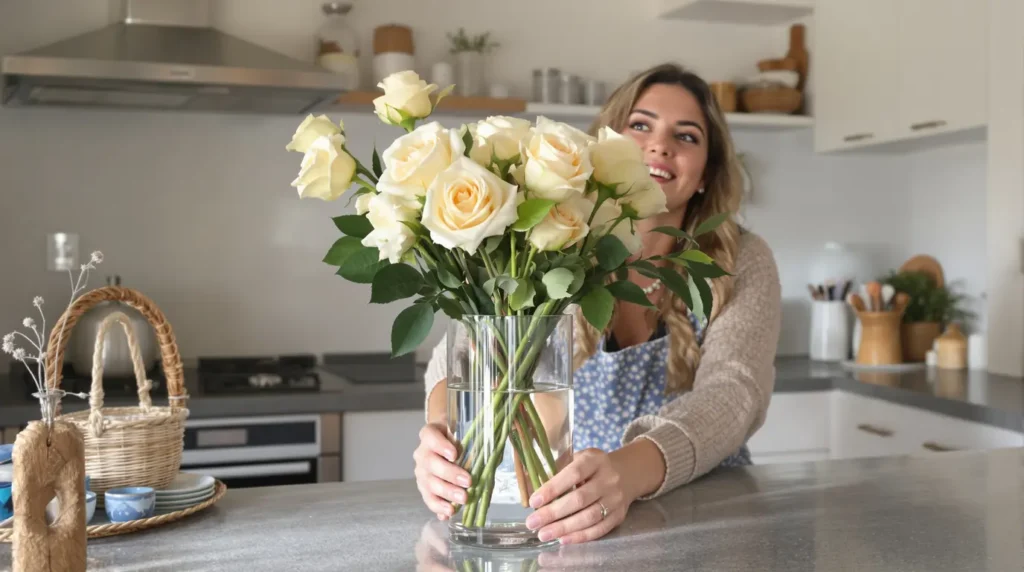
Extend the life of your roses with This simple trick
Have you ever noticed how quickly your roses wilt, leaving you wondering if there’s a simple home remedy to keep them fresh for longer? Well, there is! A straightforward technique from the kitchen can double the lifespan of your cut flowers in a vase. Follow this method, and you’ll see a remarkable difference.
Why do your roses fade so soon?
Once cut, a rose loses its roots, which means it can no longer access its primary source of sugar. Without this vital energy, the flower struggles to open its buds and maintain firm petals. Moreover, tap water can become a breeding ground for bacteria, which clog the stem and hinder the uptake of water. The result? Wilting petals, drooping stems, and murky water.
The game-changing duo: sugar and white vinegar
Sugar provides the energy that the plant can no longer produce, helping the buds to open beautifully and keeping the petals firm. On the other hand, white vinegar acts as a safeguard against bacterial growth, slightly acidifying the water to create an environment less hospitable to microbes. Together, these two ingredients strike a perfect balance between nourishment and hygiene.
A simple and reliable method
Here’s how to prepare a solution for a vase of approximately 1 liter. Feel free to adjust the quantities for larger or smaller vases.
- 1 liter of room temperature water
- 1 tablespoon of granulated sugar
- 1 tablespoon of white vinegar (or 2 tablespoons if the vase is half full)
Preparing the Stems: Cut the stems at an angle, trimming 2 to 3 cm off each one. Remove any leaves that might touch the water. Place the flowers in the vase without delay.
Preparing the Vase: Rinse the vase thoroughly. Dissolve the sugar in the water, then add the vinegar. Stir the mixture and pour it into the clean vase.
Maintenance: Change the water every two days. Each time you do, wash the vase and trim the stems by another 2 to 3 cm. Refill with the same sugar and vinegar solution. Keep the bouquet in a cool spot, away from fruits.
Variations and other possible ingredients
Depending on your water quality and preferences, there are several alternatives:
- Baking soda: A small pinch (or 1 teaspoon per liter) can help stabilize the pH if your water is heavily chlorinated.
- Bleach: A few drops, well-diluted, can slow microbial growth. Use cautiously and only by adults.
- Aspirin: Often mentioned, but results vary among horticulturists.
- Popular remedies like copper coins or vodka: Their effects are irregular and not well-documented scientifically.
Overall, the sugar and vinegar combination remains the simplest and most effective solution for most households.
Common mistakes to avoid
- Leaving leaves in the water: This significantly increases bacterial growth, so always remove them.
- Cutting stems flat: An angled cut enhances water absorption. Don’t wait to place the roses in the vase after cutting.
- Keeping the water for more than 48 hours: Even if it looks clear, microorganisms settle in quickly. Also, avoid placing the bouquet near fruit baskets or heat sources.
What to expect
By maintaining proper hygiene and using the suggested solution, your roses can stay vibrant for 10 to 14 days, or even longer depending on the variety and initial condition of the buds. Choose flowers with firm buds and keep them in a cool room to maximize their longevity.
Try this method with your next bouquet, and you’ll discover that a simple kitchen trick can truly transform the life of your cut flowers.