
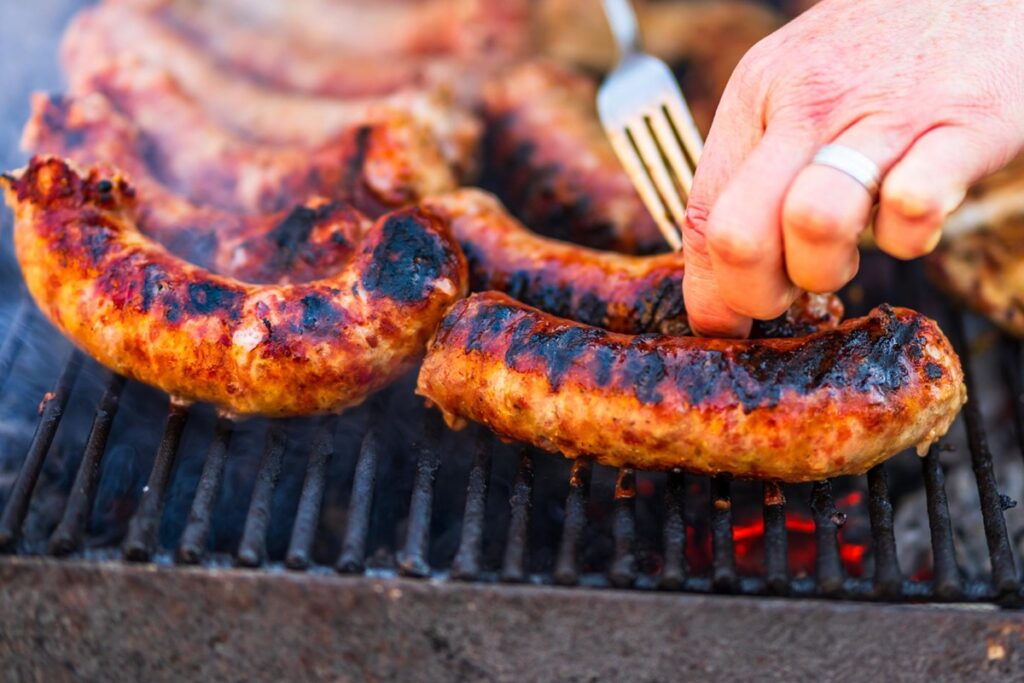
Everyone thinks they are doing the right thing by pricking sausages on the grill. This familiar reflex is actually a trap for your barbecue.
It is a classic scene: the embers are glowing, the sausages arrive, and you instinctively reach for a fork to prick them “to let the fat out.”
While this gesture feels reassuring, it is exactly what ruins the sausage.
Pricking them does not make them lighter or healthier. Instead, it dries them out, encourages flare-ups, and increases the least recommended parts of outdoor cooking.
Understanding the science behind the grill will help you change your habits without losing the pleasure of a good meal.
What really happens when you prick your sausages
A sausage in a natural casing acts like a small pressure cooker. Under heat, the trapped water and lipids build pressure and cook the meat from the inside.
According to technical studies on cooking thermodynamics and haccp standards shared by the university of ottawa, the maillard reaction (which creates the golden crust) starts around 285 °f, while pork is considered safe at an internal temperature of 160 °f.
As long as the casing remains intact, the juices stay inside, making the meat incredibly moist. The moment you prick it, this cooking chamber empties. Fat and water escape, leaving the sausage with a dry and mealy texture.
Why pricked sausages make the barbecue more toxic
When the fat from pricked sausages drips onto embers that easily exceed 570 °f, it burns instantly. This causes flames that blacken the meat and release polycyclic aromatic hydrocarbons (pahs).
By pricking your sausages, you increase this phenomenon: more dripping juice leads to more flames and toxic smoke coating your food.
To limit these compounds, experts recommend placing the grill at least 4 inches above the embers and maintaining a cooking temperature around 430 °f.
The right method to grill like a pro
The secret to a juicy sausage starts with quality. Artisanal sausages with natural casings hold up much better under heat than low-end products. They are less likely to burst and stay juicy without any help from a fork.
How to cook them:
- Aim for a two-zone setup: embers on one side for searing, and a cooler zone on the other.
- Take the sausages out of the fridge a bit early and pat them dry to help with browning.
- Start with indirect heat for about 10 minutes, turning them regularly.
- Finish directly over the embers for 2 to 3 minutes to get that golden maillard crust.
- Use a meat thermometer to reach the recommended 160 °f at the center.
Throughout the process, always use flat-tipped tongs, never a fork. If a sausage swells too much, simply move it to a cooler area of the grill.
This is the guarantee of a barbecue that smells like delicious grilled meat, not burnt fat.